
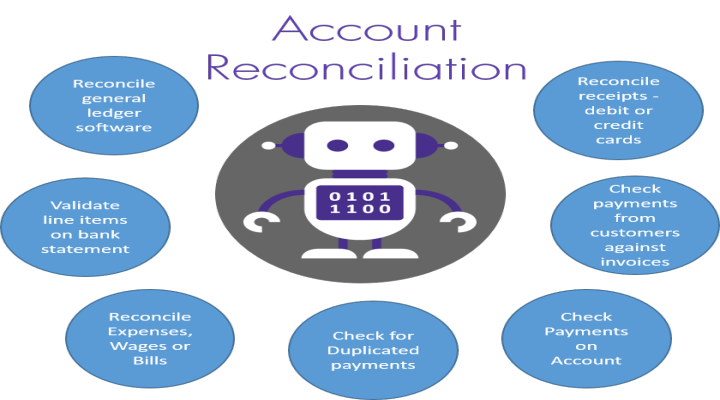
Account reconciliation is one of the most critical yet time-consuming processes in accounting. Finance teams spend countless hours matching transactions, identifying discrepancies, and validating balances across multiple systems. Manual reconciliation not only slows down financial close cycles but also increases the risk of errors. This is where Robotic Process Automation (RPA) delivers immediate and measurable value.
What Is RPA in Account Reconciliation?
RPA uses software bots to mimic human actions such as logging into systems, extracting data, comparing records, and updating results. In account reconciliation, RPA bots automatically collect data from ERP systems, bank statements, sub-ledgers, and spreadsheets, then match transactions based on predefined rules.
Unlike traditional automation, RPA works with existing systems without major changes, making it a fast and cost-effective solution for finance teams.
Key Reconciliation Use Cases for RPA
RPA is especially effective in high-volume, repetitive reconciliation scenarios:
- Bank Reconciliation: Bots match bank statements with general ledger entries, flag exceptions, and generate reconciliation reports.
- Intercompany Reconciliation: Automated comparison of intercompany balances across entities and currencies.
- Accounts Receivable & Payable: Matching invoices, payments, and credit notes across systems.
- Suspense Account Clearing: Continuous monitoring and automated clearing of aging suspense items.
By automating these tasks, RPA reduces dependency on spreadsheets and manual cross-checks.
Benefits of Using RPA for Reconciliation
The impact of RPA on reconciliation is immediate and tangible:
- Faster Period Close: Bots operate 24×7, significantly reducing reconciliation cycles.
- Improved Accuracy: Rule-based matching minimizes human errors and inconsistencies.
- Audit Readiness: Every action performed by RPA is logged, creating a clear audit trail.
- Cost Reduction: Finance teams can focus on analysis instead of repetitive data handling.
- Scalability: Bots easily handle increased transaction volumes without additional headcount.
For organizations managing multiple entities or high transaction volumes, RPA becomes a strategic necessity rather than an operational improvement.
RPA vs Manual Reconciliation
Manual reconciliation depends heavily on individual expertise and availability. RPA, on the other hand, delivers consistent outcomes every time. While humans are still needed to review exceptions and apply judgment, bots handle up to 80–90% of routine reconciliation work.
This hybrid model improves control while retaining financial oversight.
Best Practices for Implementing RPA
To succeed with RPA in reconciliation:
- Start with rule-based, high-volume accounts
- Standardize data formats before automation
- Define clear exception-handling workflows
- Integrate RPA outputs with approval and audit processes
- Monitor bot performance continuously
The Future: RPA + AI
While RPA excels at rule-based tasks, the future lies in combining RPA with AI. Intelligent automation can handle judgment-based exceptions, anomaly detection, and predictive reconciliation—paving the way toward autonomous finance operations.
Conclusion
RPA transforms account reconciliation from a manual bottleneck into a streamlined, reliable process. Organizations adopting RPA gain faster closes, improved compliance, and a stronger foundation for intelligent finance transformation.